
.png)
Expanding Access to Its Legal-Grade AI Platform
Paris, France — September 23, 2026
Questel today announced the upcoming launch of a new Assistant entry point for Qthena, expanding the way legal and IP professionals can interact with the platform.
The new interface complements Qthena’s established project-based Digital Workspace, giving users a direct way to start and manage AI-assisted work while preserving the platform’s core strength: supporting high-quality outcomes in complex, document-heavy workflows.
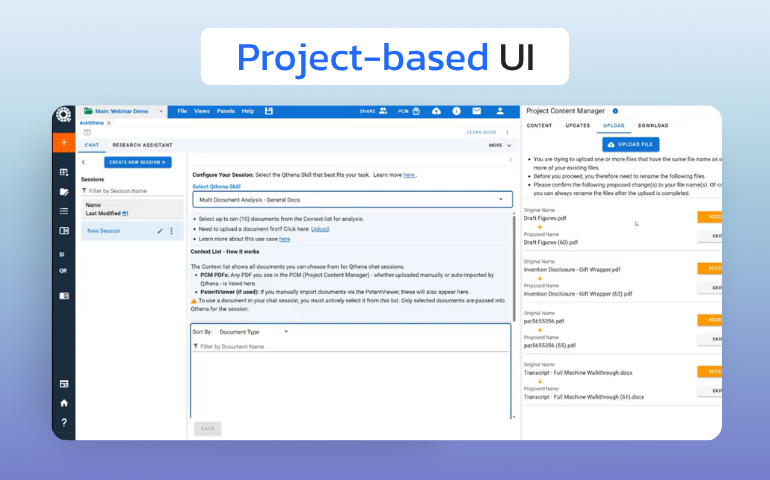
Qthena pioneered the project-based AI platform for knowledge workers handling sophisticated legal and IP matters, including patent prosecution, oppositions, portfolio review, claim analysis, and other document-intensive tasks. Within Qthena projects, users can organize documents, arrange dedicated panels, open multiple project views, work with document and chat panels side by side, and continue complex workflows in a structured environment.
This project-based approach remains central to Qthena. It is designed for professionals who need more than a simple chat window: they need a digital workspace that keeps documents, analysis, annotations, tools, and AI interaction connected in one place.
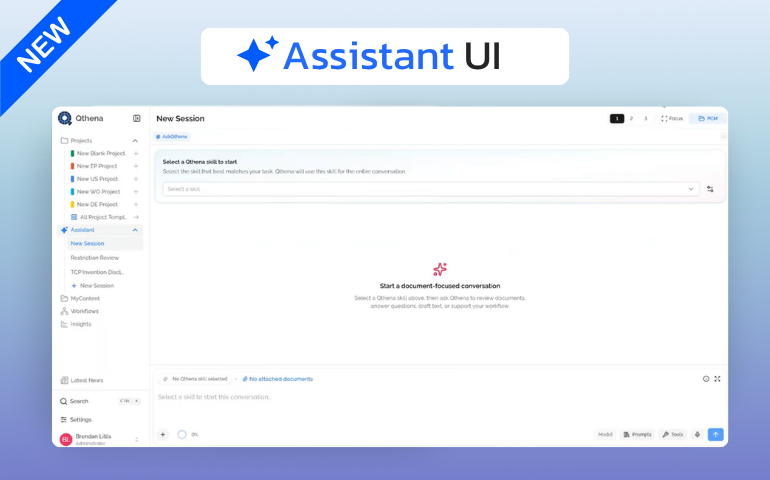
With the new Qthena Assistant entry point, Questel is adding another way to access Qthena.
Users can now begin directly with an assistant-style interaction, manage multiple assistant chat sessions more easily, and access Qthena capabilities without first setting up a full project workspace.
This provides a familiar and direct entry experience while still connecting users to the deeper Qthena environment when needed.
“Over three years ago, we pioneered a project-based approach to legal AI interaction because we understood that serious legal and IP work does not happen in a single prompt,” said Tony Afram, CEO and Founder of Qthena.
“Our users work on complex, document-heavy matters such as oppositions, prosecution, claim analysis, and strategic portfolio reviews. They need more than an off-the-shelf chat interface. They need a purpose-built environment that helps them achieve the highest possible quality. With the new Assistant entry point, we are entering the agentic era of Qthena by giving users a more direct way to start and manage assistant-led sessions, while staying true to our core vision: legal-grade AI built around real workflows, not generic tools.”
The new Assistant entry point reflects the next phase of Qthena’s evolution.
As AI systems become more agentic, users increasingly need flexible ways to interact with specialized assistants, tools, and workflows.
Qthena now supports both modes: a direct assistant-led experience for fast interaction, and the full project-based Digital Workspace for advanced,structured work.
This dual-entry approach allows Qthena to serve different moments in a professional workflow. A user may start directly with an Assistant to ask a question, review a document, or initiate a task.
When the work becomes more complex, the user can continue in Qthena’s project-based environment, where documents, tools, AI outputs, and review steps can be managed in a structured and persistent workspace.
Unlike generic AI wrappers, Qthena is purpose-built for legal and IP professionals. The platform combines specialized AI skills, document understanding, structured review environments, and workflow-specific tools. Its panel-based architecture allows users to work with documents, chats, analytics, and dedicated tools in one connected environment.
The launch of the Assistant entry point is part of Questel’s broader roadmap to bring agentic AI workflows into Qthena while maintaining the focus on quality, traceability, and professional usability.
“Qthena has never been about copying what general-purpose AI tools do,” Afram added. “Our mission is to build the best possible AI environment for legal knowledge work. More than three years ago, we pioneered a skills-based approach to generative AI interaction, giving professional users guided, workflow-specific capabilities long before this became the market standard. We also pioneered project-based AI interaction for complex, document-heavy matters. The new Assistant entry point builds on this foundation: sometimes users need a direct assistant experience, and sometimes they need a powerful project workspace. The innovation is that Qthena can support both - with one consistent focus: helping professionals produce better work.”
The new Assistant entry point will be made available to Qthena users aspart of the latest UI release.
About Qthena
Qthena is a legal-grade AI platform designed for IP and legal professionals working on complex, document-heavy workflows. Unlike generic AI chat tools, Qthena combines purpose-built AI skills, advanced document understanding, structured project workspaces, assistant-led interaction, and dedicated review tools in one unified environment.
Users can work directly with AI assistants or manage more complex matters inside Qthena’s project-based Digital Workspace, where documents, chats, annotations, analysis, and workflow-specific tools remain connected.
Qthena is built to help professionals move from information overload to high-quality outputs faster, supporting use cases across patent prosecution, oppositions, portfolio review, claim analysis, trademark matters, and broader legal knowledge work.
%20(1).png)
.avif)